Key Signals and Opportunities
So, some highlights of most interesting tech sector announcements past week and how it impacts or going to impact our supply chain realities:
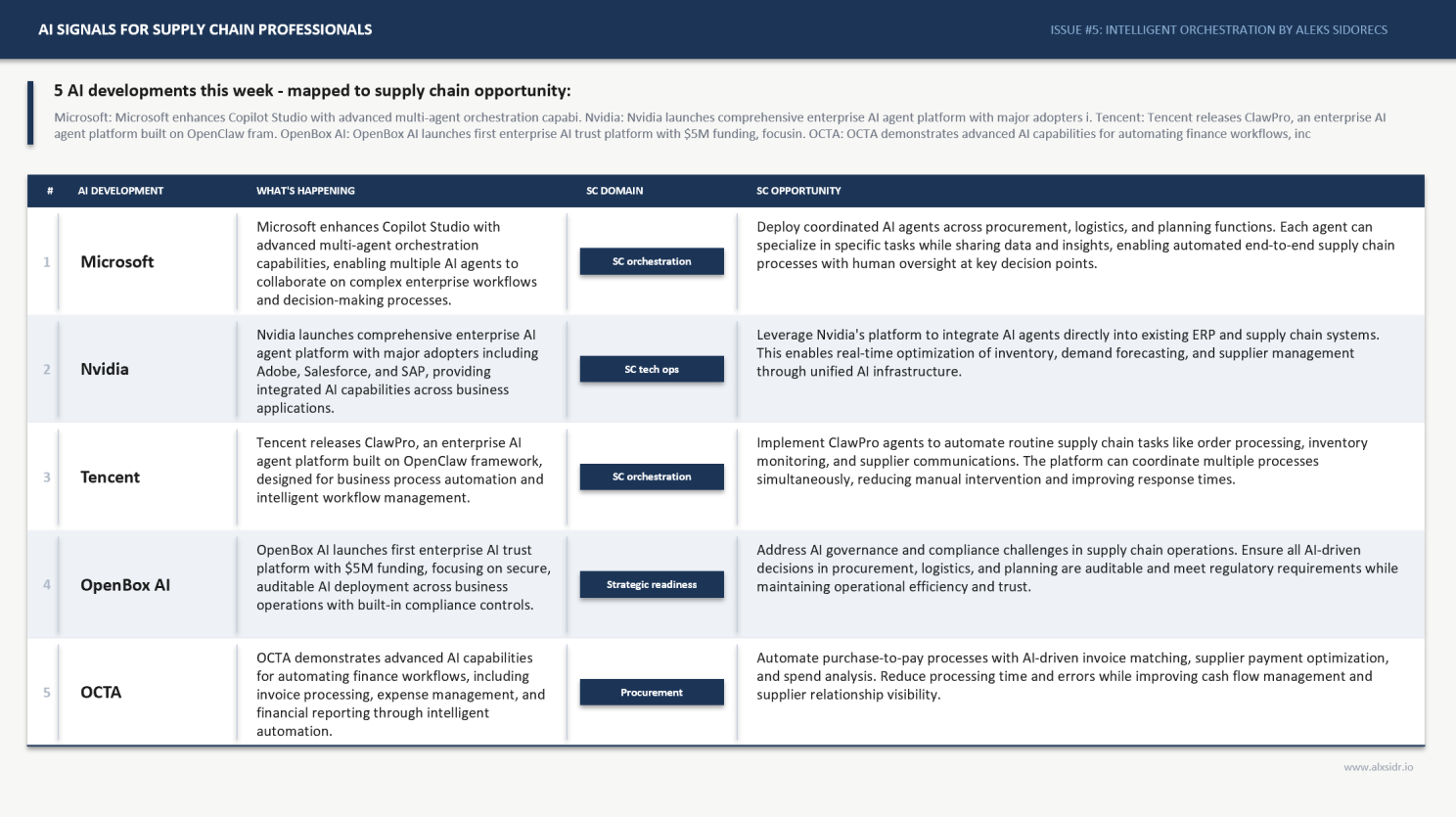
In this feed, NVIDIA deserves a special attention. This matters for supply chain operations because it solves the integration nightmare that has kept AI agents on the sidelines. Most supply chain AI pilots fail not because the algorithms don't work, but because they can't play nicely with existing ERP systems, supplier portals and operational databases.
Nvidia's platform changes this equation by providing standardised interfaces that let AI agents plug directly into SAP , Oracle , Microsoft Dynamics 365 and other core supply chain systems. An AI agent running on this platform can monitor inventory levels in your ERP, check supplier delivery performance in your TMS, analyse demand patterns in your planning system and then automatically adjust procurement parameters - all without custom integrations or middleware complexity. Time-to solution is going to be insane and fast. Can`t wait for this.
Reflecting on a broader context
The enterprise AI playbook is being rewritten daily. News that I shared above and in previous issues highlight to me one thing: we're moving into "bring your own agent" market realities. We are not there yet, but with such a speed... lets use a bit of imagination here.
The shift isn't just philosophical. We're likely to witness the emergence of what I would call "augmented hiring" - recruiting for human-AI teams rather than traditional roles. Instead of seeking a demand planner with 10 years of experience, company leaders might as ask: what happens when we pair a sharp analytical mind with an AI agent that processes market signals in real-time?
Individual professionals are starting to reshape their own careers around this reality. Based on my conversations with peers at CIPS Switzerland 🇨🇭 and Swiss Supply Chain & Logistics Conference networks, I'm very excited to see supply chain practitioners actively learning to work with AI tools not as a compliance exercise, but as a way to amplify their own capabilities. They understand that the person who can effectively orchestrate both human insights and machine intelligence will be invaluable.
The technology foundation is finally mature enough to support this personal approach. Modern AI agents can maintain context across complex supply chain scenarios, learn from individual working styles, and integrate with the systems each professional uses daily. The difference is these aren't rigid process automation tools - they're adaptive reasoning systems that complement personal judgment and expertise.
What makes this particularly compelling for supply chain professionals is how it addresses the cognitive overload many face. A procurement specialist might manage hundreds of suppliers across dozens of categories - the AI agent handles continuous monitoring whilst the human focuses on relationship building and strategic decisions.
We can go further and imagine even broader context of any COO in the future with a role being shaped from operations offices to... Chief Orchestration Officer.
Why this matters for supply chain operations
The traditional hiring challenge in supply chain has always been finding people who combine analytical rigour with operational intuition. Supply chain professionals often describe feeling overwhelmed by the breadth of expertise required - market analysis, risk assessment, relationship management, cost optimisation - all whilst maintaining service levels and managing not just a trade-offs (e.g. quality vs cost) but real contradictions that often are created by various VUCA factors.
Augmented hiring changes what we look for in people entirely. Instead of seeking candidates with deep expertise across every domain, hiring managers can focus on core human capabilities - critical thinking, stakeholder management, adaptability - knowing that AI agents can provide domain-specific intelligence and analytical support.
For individual professionals, this shift is liberating. A supply chain analyst no longer needs to be a statistical wizard to excel at inventory optimisation. They can focus on understanding business context and stakeholder needs whilst their AI agent handles complex calculations and pattern recognition. The human provides judgment; the agent provides computational power.
This approach particularly benefits professionals early in their careers or those transitioning into supply chain roles. The learning curve becomes less about mastering every technical skill and more about developing the judgment to effectively collaborate with AI systems. Senior professionals, meanwhile, can extend their influence by managing more complex networks through AI-augmented decision-making.
The best supply chain professionals I know are already thinking this way. They're not threatened by AI; they're actively learning how to leverage it.
My take on this... even quite speculative
From my experience (re-) building supply chain operations across multiple industries and continents, the bottleneck has never been computational power - it's been helping people maintain situational awareness whilst making sound decisions under uncertainty. The best professionals I've worked with share a common trait: they know what they don't know, and they proactively seek tools and insights to fill those gaps.
AI agents represent the ultimate gap-filling technology for individual professionals. They don't replace human judgment; they extend personal capability by providing continuous monitoring, pattern recognition, and scenario analysis that would be impossible for any individual to maintain manually. The art of the possible shifts from managing complexity to orchestrating intelligence.
The question isn't whether AI will transform supply chain careers, but how quickly professionals can evolve their own skills and working methods to leverage this new paradigm. The window for personal competitive advantage is narrowing, but the opportunity for those who act is substantial.