In my previous article, we established a fundamental reality: not all supply chains share the same architecture. While symmetric networks - automotive, aerospace, industrial machinery - operate on Newtonian logic, predictable and proportional, a second class of networks operates entirely differently. These are Asymmetric Supply Chains: highly fragmented, often biological or commodity-driven systems governed by Chaos Theory and structurally shaped like an hourglass.
The industries that fall into this category - agri-food, wild fisheries, rare earth extraction, diamond mining - share a common challenge. For years, the default response has been to force these chaotic networks into a linear, symmetric mold using traditional ERPs and legacy management models. The results are consistently poor.
You cannot optimize an asymmetric network using tools designed for a predictable, interdependent assembly line.
If we accept that asymmetry is a foundational feature of these networks - not a flaw to be corrected - then our objective changes completely. We must stop trying to eliminate the asymmetry and start engineering for it.
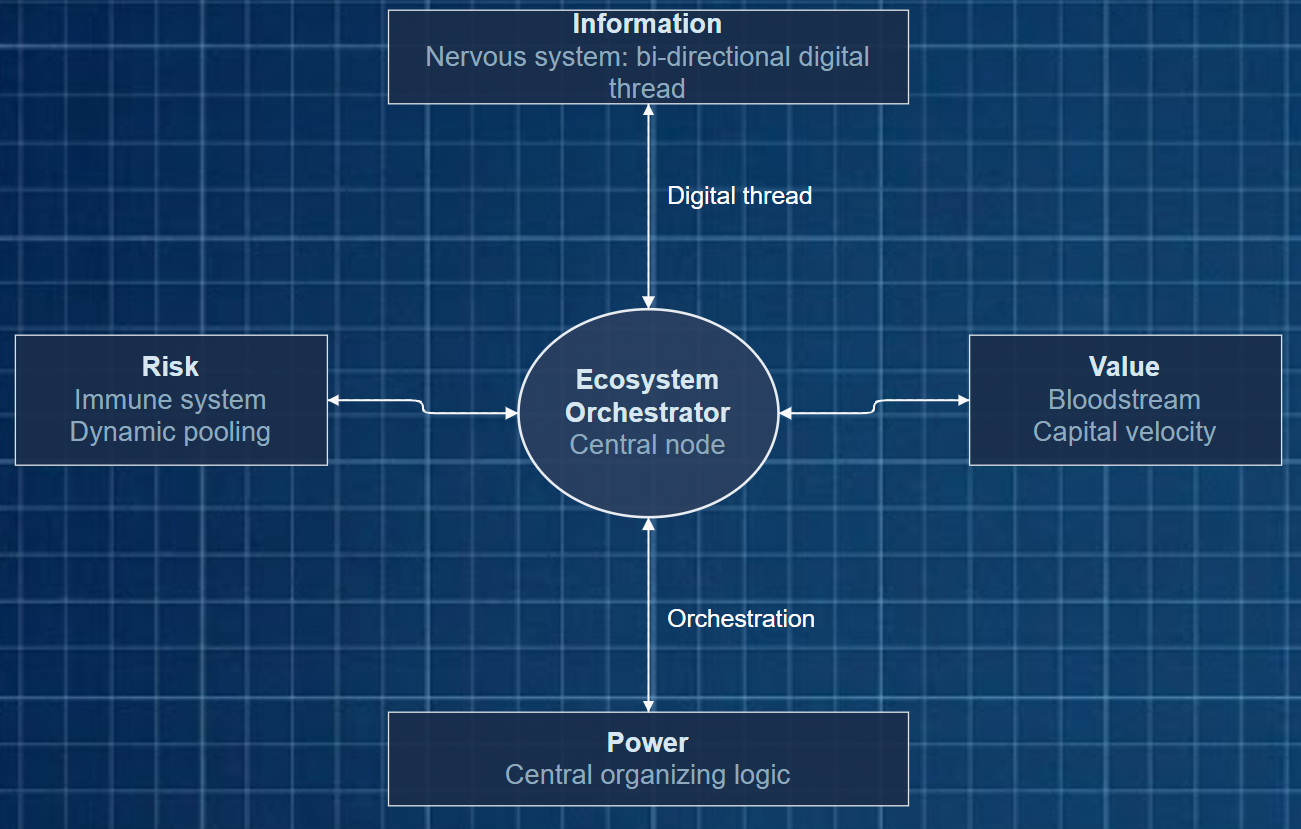
This requires a fundamental shift in how we approach Operating Model Design and Technology Transformation. The structural characteristics of asymmetric networks are not constraints to overcome. They are design parameters to be actively managed. The question is no longer "How do we make this look like automotive?" It is "What operating model is purpose-built for this environment?"
Here is how we must re-engineer four core variables - Information, Risk, Value, and Power - to build a resilient, high-performance operating model for any asymmetric network.
Information: From Silos to the Digital Thread
In a traditional symmetric supply chain, data is highly integrated because the players are tightly interdependent. In the asymmetric hourglass, information is naturally stratified by structure. The consolidated middle tier aggregates macro-level intelligence - commodity futures pricing, global demand forecasts, satellite monitoring, predictive modeling - while the fragmented production base holds micro-operational reality: localized conditions, immediate output metrics, ground-level quality signals.
Both layers are rich in data. The challenge is not scarcity of information; it is the absence of architecture to connect them.
The engineering response is a bi-directional Digital Thread. A modern operating model does not simply aggregate data at the centre - it builds a nervous system that flows in both directions. IoT connectivity at the production level, decentralized traceability ledgers, and AI-powered demand modelling can bridge these two worlds. Central nodes gain granular, ground-level visibility into supply reliability and quality. Peripheral nodes receive demand signals and operational intelligence faster, enabling proactive planning rather than reactive adaptation to shifts they cannot yet see.
This is not a technology procurement decision. It is an architecture decision that must be embedded at the operating model level before any platform is selected.
Risk: From Systemic Exposure to Dynamic Pooling
Asymmetric networks, operating under Chaos Theory, are acutely sensitive to the Butterfly Effect. A localized disruption - a regional frost in a coffee-growing region, a monsoon failure in a mining corridor, a port closure in a critical logistics hub - can cascade through commodity markets within hours, reshaping procurement economics globally and destabilizing entire producer communities in its wake.
The conventional response has been to allow these shocks to absorb naturally through the chain's structure - which, in an asymmetric network, means they concentrate at the fragmented base. This is not a passive inevitability. It is an engineering choice that, over time, erodes the very supply base that central buyers depend on for continuity.
Smart operating models approach risk as a poolable, distributable resource. By integrating predictive analytics capable of detecting early signals of climate, geopolitical, or market stress, organizations shift from reactive crisis management to anticipatory design.
Leading practitioners are going further - embedding FinTech and InsurTech capabilities directly into their supply chain architecture. Through parametric smart contracts, liquidity buffers or coverage mechanisms can be automatically triggered when specific thresholds are crossed, creating a built-in immune system for the network rather than leaving the edges perpetually exposed.
Value: From Friction to Capital Velocity
One of the most underappreciated operational inefficiencies in asymmetric networks is capital friction. The physical distance between where value is created - at the fragmented production base - and where it is realized - at the retail shelf or end market - is enormous. The financial distance is often even greater.
Moving working capital from the consolidated center to the fragmented base is slow, expensive, and opaque. Peripheral producers frequently operate without the liquidity needed to invest in quality inputs, process improvements, or output consistency. This is not an ethical observation; it is a direct operational inefficiency that undermines supply security and quality reliability for every node upstream.
The engineering solution is to treat capital velocity as a supply chain KPI in its own right. By digitizing physical goods at the point of origin - through tokenization, digital provenance records, or commodity-linked financial instruments - central nodes can enable supply chain financing that releases working capital to producers far earlier in the commercial cycle. When capital moves faster and with less friction through the network, peripheral producers can invest in the stability and quality that the whole system requires. Efficiency flows upward across every tier.
My experience managing structured procurement and vendor ecosystems at Procter & Gamble and Johnson & Johnson reinforced a consistent lesson: much of supply chain performance is determined by how capital flows, not only how goods flow. In asymmetric networks, where that capital gap is structural and extreme, this principle becomes even more consequential.
Power: From Structural Bottleneck to Ecosystem Orchestration
In the hourglass model, the narrow neck - the consolidated trading houses, processors, and major buyers - holds structural leverage simply by virtue of their position. Historically, that leverage has been exercised primarily through price and volume terms. This is rational short-term behavior within the existing architecture.
But the architecture is changing. Regulatory pressure, ESG disclosure requirements, supply continuity risks, and the growing complexity of global trade are making pure transactional leverage an increasingly fragile long-term strategy. The consolidators who will define the next decade are those who redefine their role entirely.
Rather than acting as gatekeepers of a bottleneck, the most forward-thinking operators are positioning themselves as Ecosystem Orchestrators. They use their central position not merely to extract margin, but to deploy digital infrastructure, financing tools, and data connectivity across the network.
In doing so, they shift from owning a critical node in a chain to governing a platform. They align the incentives of millions of fragmented participants - creating the scale, reliability, and quality consistency that no purely transactional relationship could achieve.
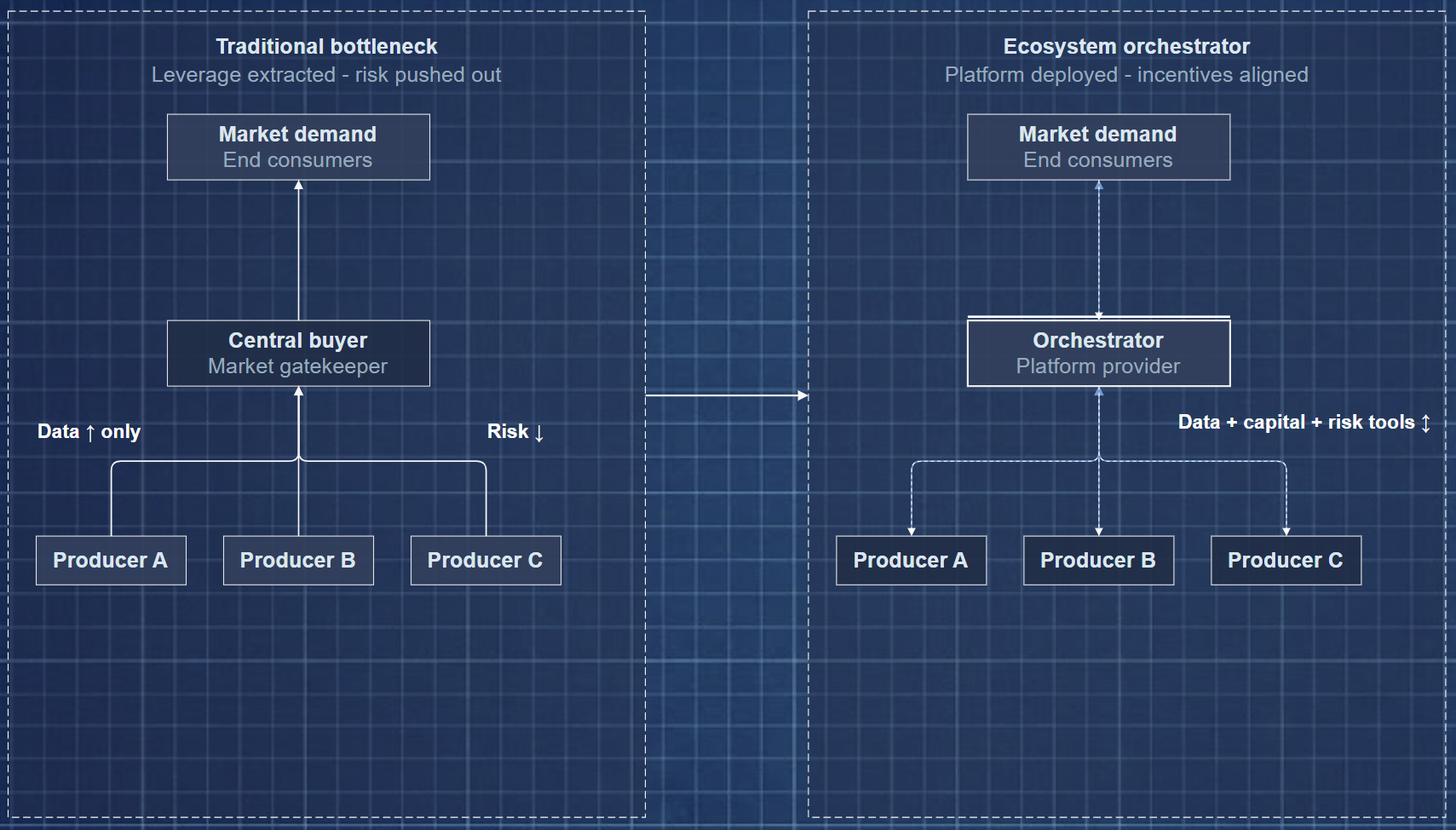
This model is not unique to agri-food. I observed its early form at Zeppelin International and Holcim, where the most effective commercial operators were not those who negotiated hardest in isolation, but those who built capability ecosystems around their market position. The same logic applies across any asymmetric network - at a far larger and more complex scale.
The Blueprint Takes Shape
An effective operating model for any asymmetric network treats Information as its nervous system, Risk as its immune system, Value as its bloodstream, and Power as its central organizing logic.
These four variables are not independent. You cannot resolve the risk exposure at the network's edges without closing the information gap. You cannot close the information gap without challenging the power dynamic at the bottleneck. And you cannot shift the power dynamic without a deliberate orchestration strategy backed by the right technology architecture.
Recognizing asymmetry is only the first step. Engineering an operating model designed to perform within that asymmetry - rather than despite it - is where durable competitive advantage is built.
But what does this look like in practice? What is the specific technology stack required to bring this model to life at global scale?
In the third and final article of this series, we move from operating model principles to Technology Leverage Blueprints - the actual architecture of platforms, AI capabilities, and connectivity tools required to run this system at scale.
Stay tuned.