If you open a standard operations management textbook, you’ll find theories built on a foundational, unspoken assumption: symmetry.
Throughout my career - managing complex operational and supply chain flows, nodes, and end-to-end networks at companies like Procter & Gamble, Johnson & Johnson, Holcim, and Zeppelin International - I have seen this symmetry in action. Whether we are moving fast-moving consumer goods, managing heavy cement production, or coordinating industrial machinery logistics, the gold standard of operations relies on a controlled ecosystem. In these environments, buyers and suppliers are highly interdependent. Shared data, shared risk, and mutual leverage are the bedrock of success.
But what happens when we try to force this symmetrical, factory-floor logic onto a global network dictated by weather patterns, seasonality, and millions of independent farmers?
The textbook theories completely break down, and conventional experience becomes irrelevant.
When I reflect on the sector where I work past 6 years, to understand the global coffee and agri-food sectors, we have to recognize their physical and geographical realities. Coffee isn’t a widget printed on a predictable assembly line or a chemical formula mixed in a controlled lab. It’s a biological product cultivated by roughly 12.5 million smallholder farmers spread across the equatorial belt. There is no centralized conveyor belt here - only a chaotic, highly fragmented, and decentralized network.
We are not dealing with a "broken" traditional supply chain; we are operating within an entirely different architecture. I call this the Asymmetric Supply Chain.
Defining the Three Architectures
To truly understand how global trade operates today, we must move past the idea that all supply chains function the same way. We can categorize them into three distinct architectural models:
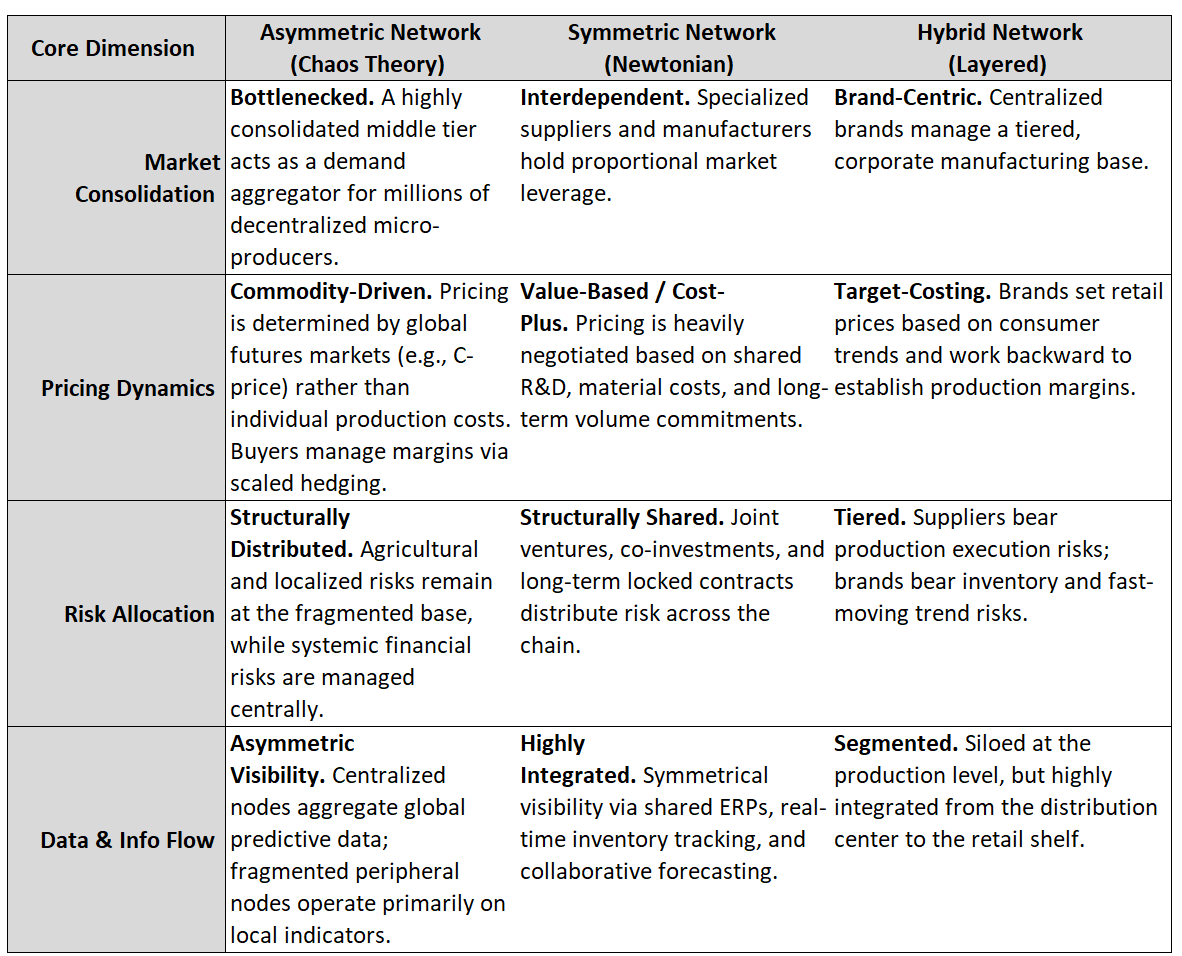
1. The Symmetric Supply Chain (Interdependent & Balanced) Symmetric networks are built on mutual reliance. Having worked with heavy equipment and industrial materials at Zeppelin International and Holcim, I’ve navigated these systems firsthand. An equipment dealer, an OEM, and a raw material provider are locked in a high-stakes partnership. Because specialized components and continuous production flows are hard to replace, power, data, and risk are distributed relatively evenly. Transparency here is an operational requirement for survival, not a luxury.
There is no centralized conveyor belt here - only a chaotic, highly fragmented, and decentralized network. We are not dealing with a "broken" traditional supply chain; we are operating within an entirely different architecture. I call this the Asymmetric Supply Chain.
2. The Asymmetric Supply Chain (Bottlenecked & Skewed) Asymmetric networks operate not as synchronized factories, but as funnels. In sectors like coffee or cocoa, millions of decentralized micro-producers form the base, while global market access and logistics route through a highly consolidated middle tier. This structural bottleneck dictates the network's physics: data and capital efficiency are centralized in the middle, while agricultural and market risks remain distributed across the fragmented base.
3. The Hybrid Supply Chain (Layered & Brand-Driven) Hybrid networks sit in the middle. My time at Procter & Gamble and Johnson & Johnson provided a masterclass in this structure. Massive central brands hold the ultimate market power and dictate consumer trends, but they don't source from fragmented micro-producers. Instead, they rely on a highly structured network of corporate factories. Suppliers absorb the production execution risks, while the central brand absorbs the inventory and fast-moving consumer trend risks.
The Physics of the System: Newtonian vs. Chaotic
To mathematically and scientifically understand why asymmetric chains act differently, we have to look at their underlying physics.
Symmetric supply chains operate on Newtonian logic. They are linear and predictable. If an automotive plant slows down by 10%, orders to the Tier-1 supplier drop by 10%. Cause and effect are proportional and easily managed by standard ERP software.
Asymmetric supply chains, however, operate strictly on Chaos Theory. They are highly complex, non-linear systems defined by the Butterfly Effect (extreme sensitivity to initial conditions). Because the base of the network is biological and exposed to the elements, a localized frost in a small micro-region of Minas Gerais, Brazil, can trigger an algorithm on Wall Street, drastically spiking the global commodity price, which in turn financially challenges the whole AgriFood ecosystem in another part of the world.
...symmetric supply chains operate on Newtonian logic. Asymmetric supply chains, however, operate strictly on Chaos Theory. They are highly complex, non-linear systems defined by the Butterfly Effect...
The Mechanics and The Global Landscape
When we compare these mechanics side-by-side, the necessity for a different management and technology leadership approach becomes obvious.
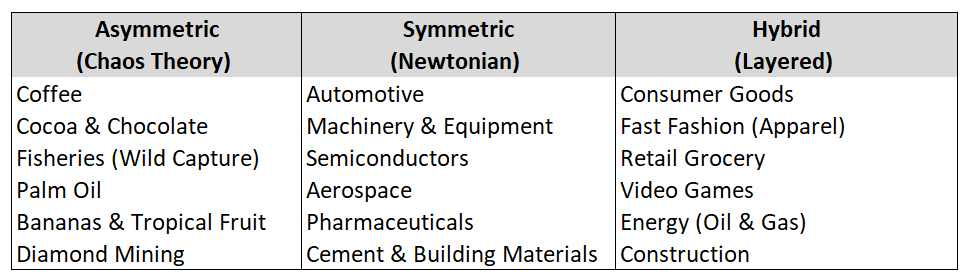
When we try to zoom out, we can categorize the broader global economy into these exact architectural buckets:
The Paradigm Shift
For decades, the agri-food industry has tried to "fix" its imbalance with linear tools like standard contracts, standard software, or process excellence tools.
But here is the paradigm shift we need to embrace: Asymmetry is not a bug in the agri-food supply chain. It is a fundamental feature. This structural imbalance isn't a malicious design; it is the architectural consequence of how this specific market formed over centuries. As long as we treat such supply chain like a broken linear pipeline rather than a complex, chaotic network, we will keep applying the wrong tools to the job, wrong automations and workflows.
Trying to manage this environment with traditional, symmetric supply chain software is like trying to measure temperature with a ruler. To successfully navigate this landscape, we first need to understand its unique physics.
Asymmetry is not a bug in the agri-food supply chain. It is a fundamental feature. Trying to manage this environment with traditional, symmetric supply chain software is like trying to measure temperature with a ruler. To successfully navigate this landscape, we first need to understand its unique physics.
In my next article, we will dissect the anatomy of this environment into four core operational variables: Power, Value, Information, and Risk.
Stay tuned.