
A super El Niño is forming over the Pacific. It is the clearest illustration yet of why asymmetry in agri-food supply chains cuts deeper than any single frost - and why a diversified supply base can be correlation in disguise.
Some people were asking me why since April 2026 why I am spending active time on researching and talking to in-house and external climate experts. The answer is simple, because I read global climate reports as supply chain strategy documents.
Let me give you some background on this first. World Meteorological Organization warned that a new El Niño is likely to strengthen through 2026 - possibly into one of the strongest events ever recorded. A so-called super El Niño, with deep-Pacific waters already running several degrees above average and a peak expected, as these events usually do, around Christmas.
A strong El Niño doesn't just move the weather - it moves my and every other global agri-food supply chain network:
- Processing capacity rebalancing - as origins run long or short, throughput shifts, leaving some mills and roasters idle while others overload
- Freight gaps and new port-pair activation - lanes redraw, and origin–destination pairs that barely carried volume last year suddenly matter
- Inventory pre-positioning - where you hold buffer, and how far ahead of the Christmas peak, turns from a default into a live decision
- Sourcing moves forward in time - qualifying an alternate origin takes months, so the call has to be made now, on a forecast, not later on confirmation
- Working capital gets repriced - higher prices, longer transit and bigger buffers inflate the capital locked inside the same physical flow
In the first article of this series, Asymmetry as a Feature, I argued that agri-food networks don't run on the Newtonian logic of the factory floor. They run on Chaos Theory. My example was a localized frost in a micro-region of Minas Gerais that trips an algorithm on Wall Street and reprices the entire global market within hours - the Butterfly Effect, a tiny local initial condition amplified across the planet.
El Niño is the same underlying physics. And the exact opposite shape.
Two faces of chaos
The frost is idiosyncratic chaos. One small point in the network moves, and the system's sensitivity to initial conditions does the rest. Local in origin, global in consequence. It is the chaos I described in first article, and it is the kind most supply chain operators in agri-food have learned to watch for: a single origin, a single event, a sharp move.
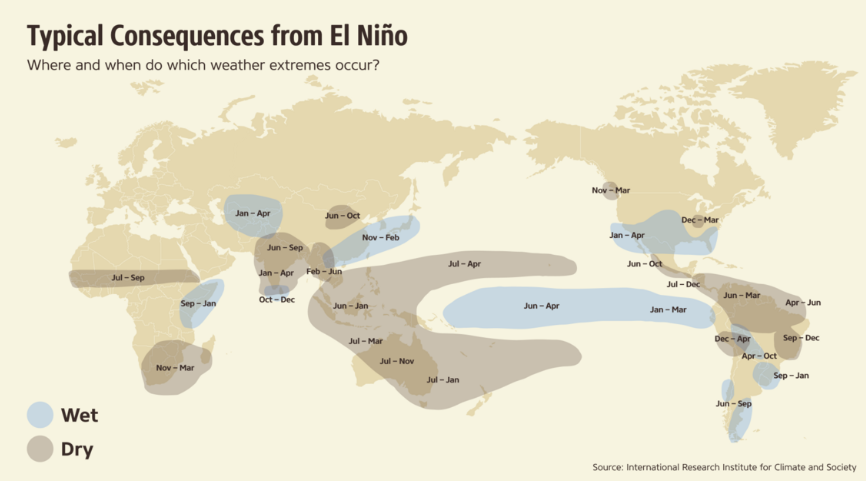
El Niño is common-mode chaos. It is not one small input amplified outward. It is a single planetary driver pressing on the entire production base at the same time. Through the atmospheric teleconnections that define El Niño, the same event tends to push heat and drought across Brazil, Vietnam, Indonesia and parts of the Horn of Africa - not sequentially, not independently, but together, because they are all responding to the same forcing in the same Pacific.
Idiosyncratic chaos is one node failing loudly. Common-mode chaos is every node failing quietly, together, for the same reason.
Look at the map the meteorologists drew of where this El Niño is likely to bring hot, dry conditions. Then overlay the world's coffee, cocoa, sugar, palm and rice base on top of it. The two maps are very nearly the same map. That is not a coincidence. It is the architecture.
Why common-mode is the dangerous one
Here is the part that should keeps agri-food supply chain peers awake.
The standard answer to supply risk in an asymmetric network is diversify your origins. Spread the base. Don't depend on one country. It is sound advice - against idiosyncratic chaos. A frost in Minas Gerais is survivable if you also buy from Colombia, Uganda and Sumatra.
But that strategy carries a silent assumption: that your origins fail independently. Common-mode chaos is precisely the event that violates it. A planetary oscillation doesn't care how many flags are on your sourcing map; it reaches all of them at once.
The diversification was real on paper. The independence behind it was not.
And in an asymmetric architecture, this lands where the network is structurally thinnest - by design.
When the cargo and the conduit fail together
There is a second-order effect that makes this worse, and it is pure systems coupling.
A strong El Niño doesn't only stress the fields. The same drought that withers the crop also lowers Gatún Lake - the freshwater reservoir that floats ships through the Panama Canal - forcing draft restrictions that throttle one of the arteries agri-food moves through. We saw exactly this in the last strong event.
Again, the shock degrades the cargo and the conduit meant to carry it, simultaneously, from a single cause. Lower yields and lower-quality throughput leave processing assets running below capacity. Volumes shift between origins, redrawing container flows and repositioning needs. And the canal that would normally help rebalance the system is itself constrained by the same drought.
This is not amplification of one point. It is the whole board moving at once.
The escape routes converge, too
The instinctive response to a short origin is to switch. Pull from the regions that weren't hit. Reroute around the constrained canal. Find spare processing, vessel and container capacity somewhere else. Against an idiosyncratic shock this works - the rest of the system is intact, and it quietly absorbs the diverted flow.
Under common-mode chaos, the escape routes are correlated as well. When the disruption reaches every major origin at once, every buyer reaches for the same handful of unaffected ones, the same alternate ports, the same spare reefer and vessel capacity, the same Suez-or-Cape detour around a draft-restricted canal - at the same time. The diversion is as synchronized as the disruption that caused it.
So the substitute origins get bid up and booked out. Processing capacity that looked like comfortable slack becomes the binding constraint, because everyone redirected volume into the same mills and roasters in the same window. Congestion migrates rather than clears. Empty and laden boxes pile up in the wrong places as equipment balances tip. The network rarely fails at the point of the shock; it fails a step downstream, where the collective workaround all arrives together.
Common-mode chaos doesn't only correlate the failure. It correlates the response. And a synchronized response to a synchronized shock is just the second wave of the same wave.
Beyond coffee
I write from coffee because it is the sector I've lived in for the past six years. But none of this is coffee-specific. Sugar in India and Thailand, cocoa across West Africa, palm oil in Southeast Asia, rice across the monsoon belt, wheat in Australia - the tropical and soft agri-commodities cluster in precisely the latitudes El Niño reorganizes.
The translation to any single crop is always probabilistic, lagged, and uneven - some regions even get more rain, and this season's harvest is often less exposed than next season's. Honesty about that uncertainty is part of the discipline. But the structural point holds regardless of how this particular event resolves: a network whose risk lives at a fragmented base, and whose diversification runs across a single climate system, has a correlated exposure it mostly isn't pricing.
Back to the feature
In first publication I have argued that asymmetry is not a bug to be fixed but a feature to be engineered for. El Niño deepens that argument. It shows the chaos in these networks has two faces: the local Butterfly and the planetary common-mode - and that the second is the one our standard playbook is often quietly unprepared for.
The forecast peaks around Christmas. The architecture, as always, was set long before.