On June 18th CIPS Switzerland 🇨🇭 and Capgemini hosted the first edition of The Invisible Chain in Zurich. I opened the evening together with Martin Weis and later handed over the session to Daniel Aebischer who reflected about challenges of articulating decision-making in the era of complexity, uncertainty and increasing disruptions.
The sharpest contribution of the night didn't come from the presentations. It came from the panel participants and audience, twice, through a live poll.
This piece is less my monologue than a synthesis of what a room of practitioners actually said when you gave them an anonymous vote and a microphone.
The room's verdict
Two questions. Two answers that should reframe how we talk about AI in operations.
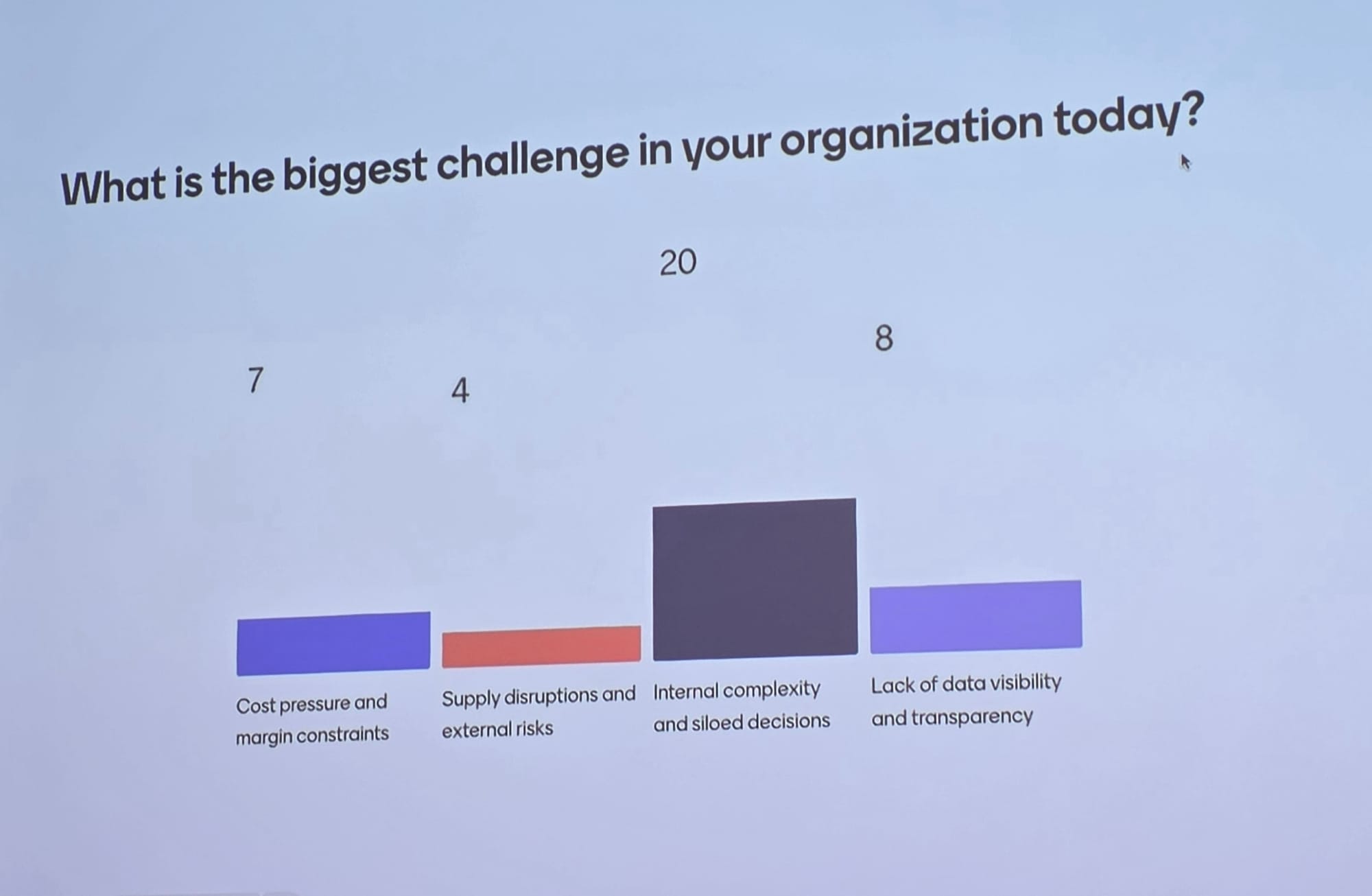
What is the biggest challenge in your organization today?
- 20 answers: internal complexity and siloed decisions
- 8 answers: lack of data visibility and transparency
- 7 answers: cost pressure and margin constraints
- 4 answers: supply disruptions and external risks
Read that again. In a year defined by tariffs, war, and shock after external shock, the room ranked external risk dead last. The thing keeping these leaders up at night isn't the world. It's their own organization - complexity and siloed decision-making, by a margin of five to one over the disruptions we spend most of our airtime worrying about.
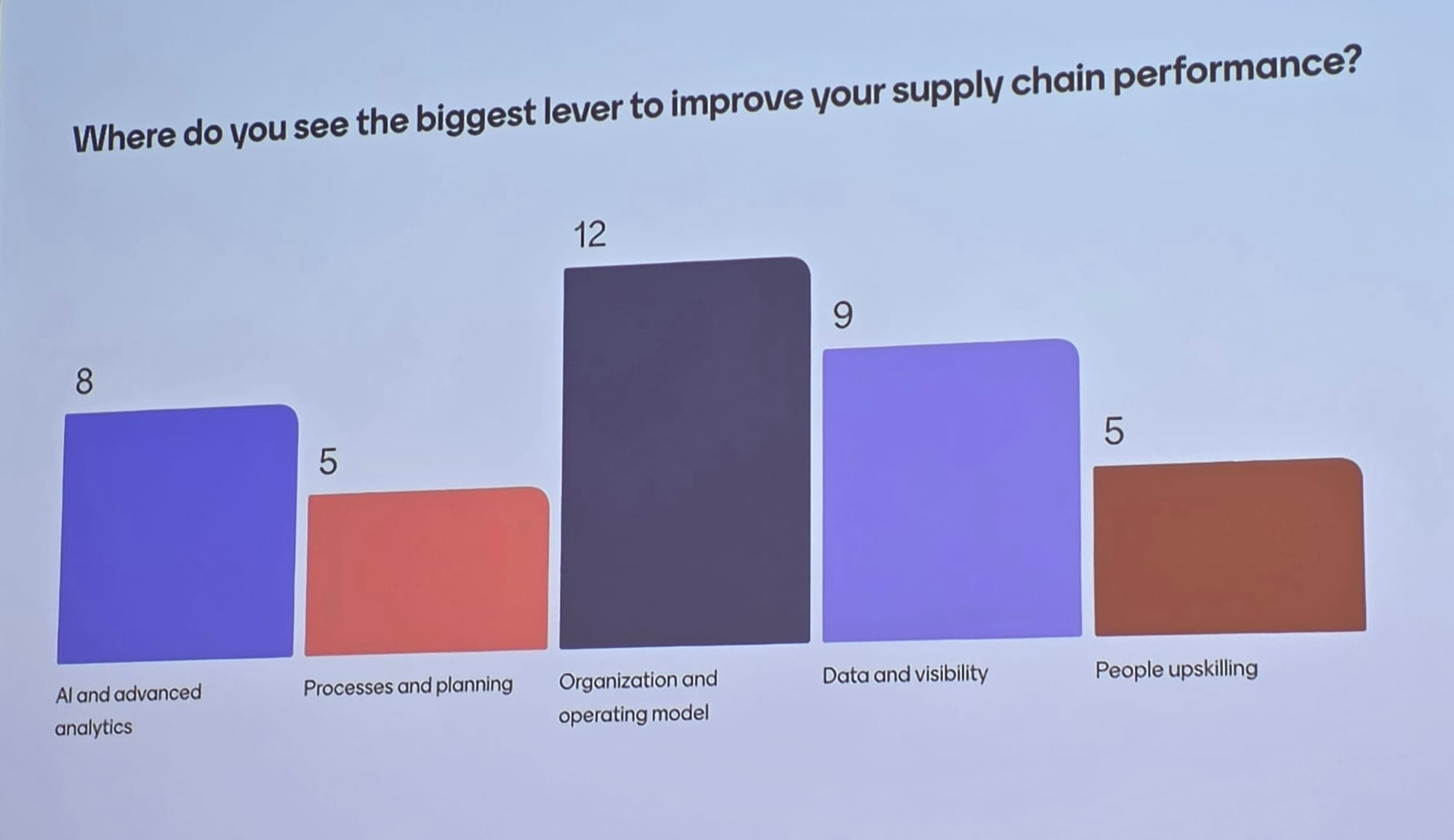
Where do you see the biggest lever to improve your supply chain performance?
- 12 answers: organization and operating model
- 9 answers: data and visibility
- 8 answers: AI and advanced analytics
- 5 answers: processes and planning
- 5 answers: people and upskilling
At an event with "AI" in the room's bloodstream, the biggest lever wasn't AI. It was the operating model. The technology came third.
Put the two polls together and the room told us something the vendors won't: the problem is internal, and the fix is structural. Not a better model. A better way of deciding.
From trade-offs to contradictions
That's exactly the shift I opened the event with.
For most of our careers, the discipline of supply chain was the discipline of the trade-off. Cost or speed. Resilience or efficiency. Service or working capital. You picked two, defended the choice, and optimised within it. The craft was knowing which lever to pull and what you'd sacrifice to pull it.
That craft no longer describes the job. The pressures we used to sequence now arrive together - tariffs, supplier concentration, energy, currency, the cost of carrying inventory - on the same P&L, in the same week, often in the same meeting.
This resonates with what Daniel Aebischer said during that day:
We thought COVID was the once-in-a-lifetime crisis. Then we got Ukraine, then the Middle East, terrorism - everything happening at the same time. It has never been this hard to make a decision.
So the question is no longer which trade-off do I accept? It's how do I hold contradictions that refuse to be held at once? Lean and resilient. Fast and robust. Cheap and adaptive. The trade-off mindset was built to choose. This moment demands you refuse to choose - and still deliver. We've moved from managing trade-offs to orchestrating contradictions, and orchestration is a different competence than optimisation.
The old reflex is still running
If you doubt we've genuinely made that shift, look at how the industry has actually responded to volatility. Roughly nine in ten supply chains have redesigned since COVID - near-shoring, friend-shoring, regionalising. Around two-thirds have diversified their supplier base. And then a clear majority simply increased inventory.
We've intellectually accepted a more volatile world and answered with the oldest, most expensive lever we own: holding more stock. That's not resilience. That's buying insurance with the balance sheet because the operating model that would let us be lean and resilient doesn't exist yet. Which is, almost word for word, what the room voted.
The objective case for AI
Here's where the machines come in - and the case is narrower and stronger than the hype.
As humans, we can reasonably weigh three or four parameters at once. Today's decisions carry ten, twelve, fifteen - moving in real time. We are simply not built for that.
Beyond a handful of variables, we don't reason better, we narrow. We drop variables to make the problem feel tractable and call the residue judgment. That is the real argument for AI in this domain: we have a cognitive ceiling, and the complexity has gone through it. AI's job isn't to replace the practitioner - it's to widen the aperture so the practitioner can finally see the whole board.
AI will not replace senior leaders. The one thing we'll have to do better than ever is decide - on the facts we're given.
The value is governance, not accuracy
The easy mistake is to think the prize is a better forecast. It isn't. A more accurate number, dropped into an organisation that can't agree who acts on it, changes nothing. Federico Scotti di Uccio during panel conversation put the real question better than any slide could:
Who is entitled to change an AI result? And who is entitled to say that result was the correct one?
Until those questions have owners, AI is an expensive way to generate suggestions everyone is free to ignore. Accuracy is table stakes. The operating model around the accuracy is where the margin lives - which is, again, what the room voted for.
Two clocks, not one
A practical pattern worth writing down: run the operation on two rhythms.
Sensing has to be daily, sometimes faster. But you also need a monthly tactical touchpoint - otherwise you have speed with no stability, and that's just expensive thrashing.
A fast clock for sensing demand and disruption; a slow clock to keep the daily reactions pointed in the same strategic direction. Resilient operating models need both, deliberately designed - not one bolted onto the other.
The partnership that actually decides
Ask who supply chain's most important partner is in this world and the instinct says technology. It's wrong. It's finance as it was very well articulated by Aleksis Plamse:
Finance is the natural partner, because balance has always been a trade-off. That's their discipline - ours is catching up.
Every contradiction we're asked to hold resolves into a number - cash, inventory, cost-to-serve, marginality. Done well, that changes the conversation with commercial leadership entirely:
I don't ask my Chief Commercial Officer what his priorities are. With finance behind the numbers, I tell him what the prioritisation should be - and I defend it.
That's only possible when supply chain and finance own the trade-off jointly and speak one language.
Where the value leaks out
And a warning that landed hard: value rarely leaks at the top. It leaks on the way down. In case I correctly made notes based on what Federico said, it is:
When leadership acknowledges the tensions but doesn't actually prioritise, it cascades to the VPs and directors to figure out. That's exactly where the value is lost.
A reduce-inventory mandate, a raise-service mandate, and a growth ambition - all live, all contradictory, handed three levels down with no adjudication. That's where strategy dies. Not in the boardroom; in the gap between the boardroom and execution. Orchestrating contradictions is a leadership act. It cannot be delegated to whoever is unlucky enough to be holding it when the music stops.
Don't automate the silo
The most quietly alarming line of the night was about AI itself. Asked where the real business impact sits, Priscilla Garibay described an organisation already well down the agentic path - and stuck:
Right now we have twenty-five agents, and they are not talking to each other - just like the people. And clearly they're not making very good decisions because of that. Orchestration is the key for the agents, but it's the key for the humans too.
She put the pressure behind it bluntly too: up to forty percent of professional work, in her estimate, is heading toward automation - but, as she warned, you can get rid of the people and still be left with no strategy if the orchestration isn't there.
Here is the part worth sitting with. We spent the whole evening agreeing that our biggest problem is internal complexity and siloed decisions - the room voted it the number-one challenge by a mile. And the instinct now is to solve it by buying agents. But an agent dropped into a siloed function doesn't dissolve the silo. It is the silo, running faster.
The hardest investment is people
The technology is increasingly the easy part. The organisation is not. And notice: in the lever poll, people upskilling scored just 5 - the most under-valued answer in the room, and quite possibly the most important. Angela Qu beautifully nailed it:
You need people who can sit in extreme ambiguity, admit some of their own recommendations will be wrong - and still tell the story of that complexity at board level. If you can't make it simple, they switch off.
Aleksis also described building an autonomous-finance capability deliberately several stages ahead of where most organisations sit, while his company partnered with technical universities to upskill their people in data science:
The autonomous-finance vision we're building runs three or four stages ahead of where most companies are today. The hard part was never the technology - it was the people.
The resistance, when it comes, rarely comes from the top or the bottom. It comes from the middle - from people who've succeeded for years doing it the old way, now asked to sit in the discomfort of not knowing. That discomfort is the job now.
What the room already knew
So here's where I landed.
The "invisible chain" was never the logistics. The containers, the lanes, the warehouses - those were always visible enough. What stayed invisible was the decision layer underneath them: the place where contradictions get held, weighted, and resolved - or quietly dropped, costing you margin you never see leave.
That layer is what AI, used seriously, finally lets us see. But the room was clear-eyed about the order of operations. Asked for the biggest lever, they didn't reach for the tool. They reached for the operating model - the way we organise, decide, and refuse to push our contradictions downhill.
We spent a generation making the supply chain invisible because it worked. The next decade is about making the decisions visible - because that's the only part that's still genuinely hard.
The people who voted already know it.