Key Signals and Opportunities
So, some highlights of most interesting tech sector announcements past week and how it impacts or going to impact our supply chain realities:
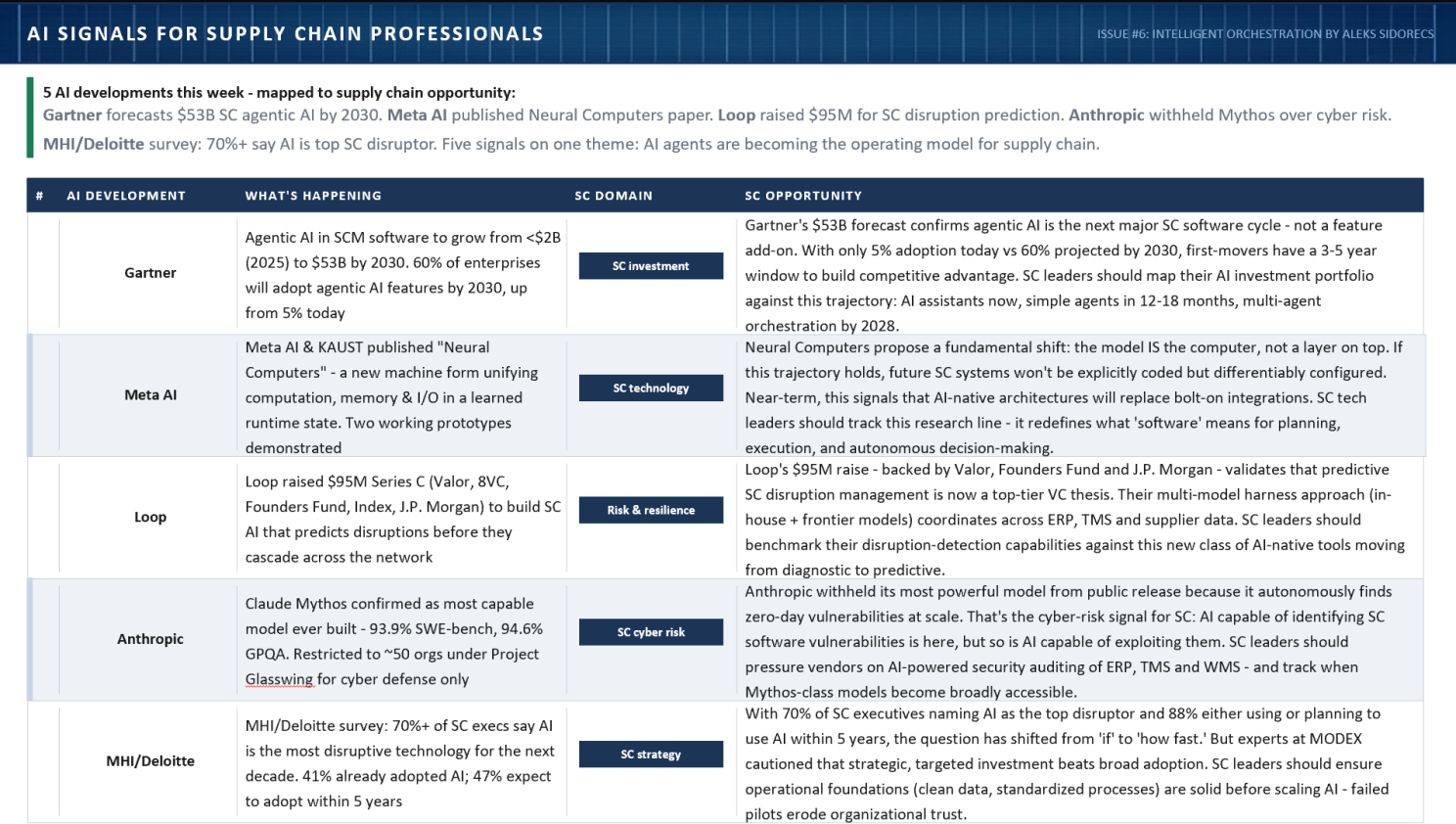
One of those numbers is worth sitting with. Garter forecasted in their April publication $53 billion in agentic AI supply chain spend by 2030, up from under $2 billion today. Enterprise adoption expected to move from 5% to 60% in five years.
But I still keep asking the same question. The money is going to land somewhere. On top of what?
At the same moment thy published back in 2025 another research: over 40% of agentic AI projects will be canceled by end of 2027. Escalating costs, unclear business value, inadequate risk controls. I find something almost honest about the combination. Gartner isn't contradicting itself - it's describing the same situation from two angles. The capital is committed. The readiness isn't. Both are true at the same time, and the gap between them is where the real story lives.
During week when I was reviewing the publication from Gartner, I got several interesting messages from Susann Kühne who is as passionate about supply chain topics as I am. She shared with me few links to LinkedIn posts with variations of the same thing: redrawing the supply chain org chart for an AI-native future.
Before AI on the left, after AI on the right. New role titles in the boxes: Supply Chain Orchestrator. AI Product Manager. App Maker. AI Remote Consultant. This came just a week after I published issue #5 of Intelligent Orchestration - the one about "bring your agent" and augmented hiring. And this keep bothering me.
Reason is that I don`t agree with any of it. Took me a while to figure out why. Part of the answer is that my own Issue #5 had done a softer version of the same thing - I reached for the Chief Orchestration Officer label as a way to rethink the seat at the top. This piece is my reflections adjustment. It ties back to arguments I already made in Issues #2 and #4 that I should have pulled together earlier.
The frame problem
Org charts are not pictures of companies. They are pictures of one specific way a company runs itself. Reporting lines. Spans of control. Approval chains. Named owner at each node.
This looks so obviously like - how organisations work, that we forget it is a choice. One we made because the alternatives were not possible.
When everyone publishing an AI-native org chart drawing agents into boxes with reporting lines, a quiet move is happening. The org chart gets treated as ground truth. Agents become the variable. As if the only question is which boxes the agents sit in and which humans they report to.
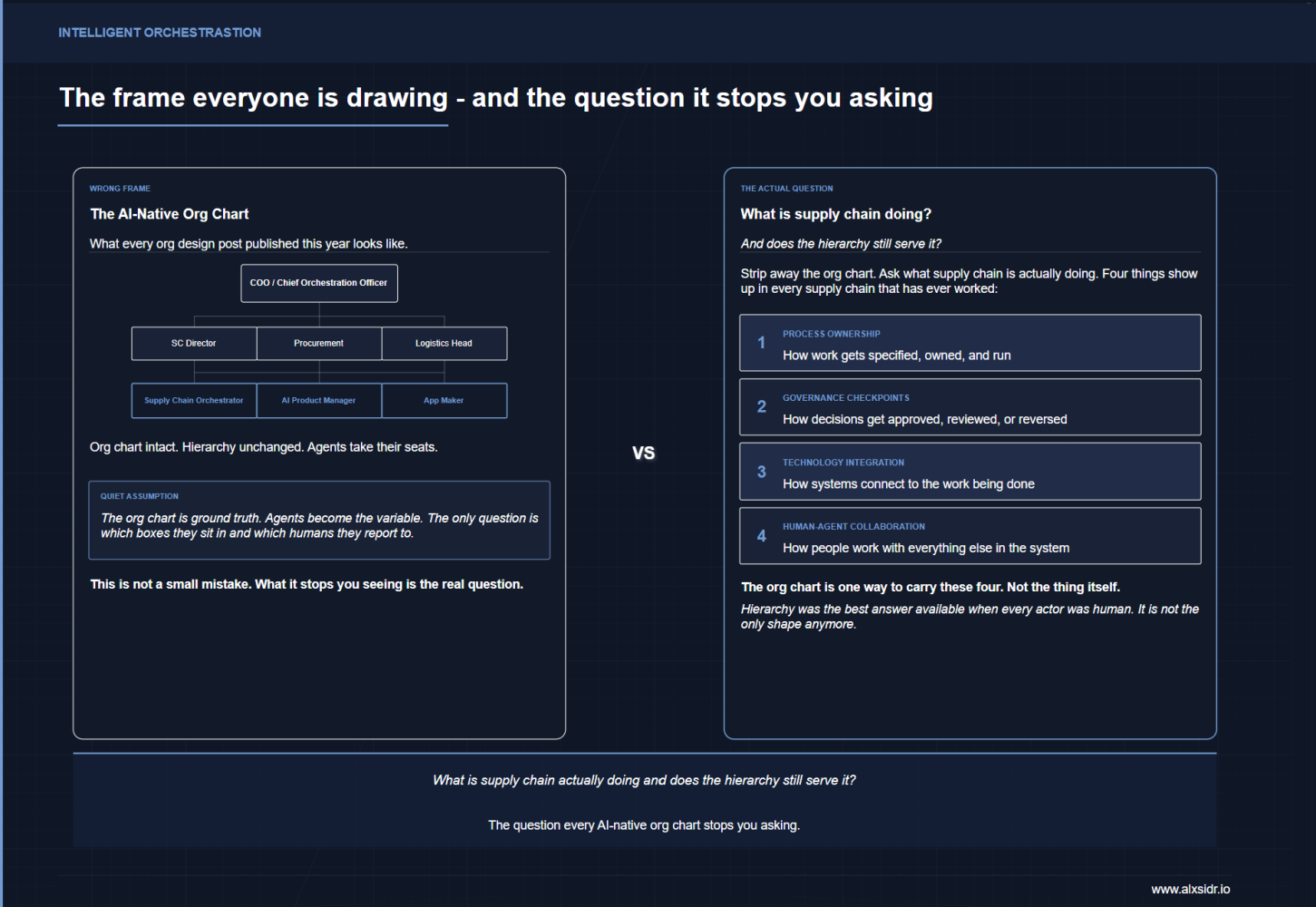
That is not a small mistake. What it stops you from seeing is the real question - the one I have been circling since Issue#2.
What is supply chain actually doing, and does the hierarchy still serve it?
The arc I haven`t stitched so far
In Issue #2, I shared that the ceiling for AI in supply chain isn't the model - it's the organisation. Introduced the Target Operating Model (TOM) with four dimensions: process ownership, governance checkpoints, technology integration, human-agent collaboration. Named the agent steward role, and described layered bounds for how much an agent can do on its own.
In Issue #4 inspired by Swiss Supply Chain & Logistics Conference and several conversations with Aleksis Plamse from Wella, I argued the real AI value lives in decision quality and compounding organisational memory, not headcount. And I closed with a line:
The measurement stack only works if the operating model underneath it is designed to support it.
This issue is that return. What neither Issues #2 nor #4 said outright - and what I'm saying now - is that the TOM isn't a different shape of the same thing. It's a replacement for what supply chain has been running on for a century.
That thing is hierarchy.
What supply chain actually runs on
Supply chain isn't a hierarchy. Supply chain is a way to run work that has been built as a hierarchy because - until recently - hierarchies were the only way humans knew how to run things at scale.
I first read Herbert Simon during my MBA and have not stopped thinking about him since. Simon's bounded rationality argument - the one he won a Nobel for in 1978 - was that hierarchy exists as a workaround for human limits.
⫸ No individual can attend to everything, process everything, be accountable for everything, so organisations build structures that delegate, specialise, and approve in layers. Simon was writing about humans. The argument still holds. It just stops applying cleanly when the actors aren't all human.
Strip away the org chart and ask what supply chain is actually doing. You end up with the four TOM dimensions from Issue #2.
Those four are always there. In every supply chain that I ever worked with at P&G, Holcim or any other company, these four dimensions got implemented in some local, ad-hoc way that worked because it carried those invariants.
The org chart is one way to carry those four. Not the thing itself.
Hierarchy carries them through people in a pyramid. Named roles with end-to-end responsibility. Decision gates where humans approve before work moves. Technology built assuming a human at the other end. Reporting lines deciding who overrides whom.
⫸ It works. It has worked for a century. Not because hierarchy is a law of nature - because humans are bounded on three axes at once (what we pay attention to, how fast we process, how much authority we can safely hold), and the pyramid is a clever workaround for all three.
It was the best answer available when every actor in the system was human.
Why the workaround breaks
Agents don't share those bounds.
⫸ An agent isn't bandwidth-limited the way a human is. It doesn't run on a weekly review cycle. It's not accountable through a named seat. Whatever accountability it has must come from somewhere else - policy, audit trails, bounds, the agent steward role from Issue #2.
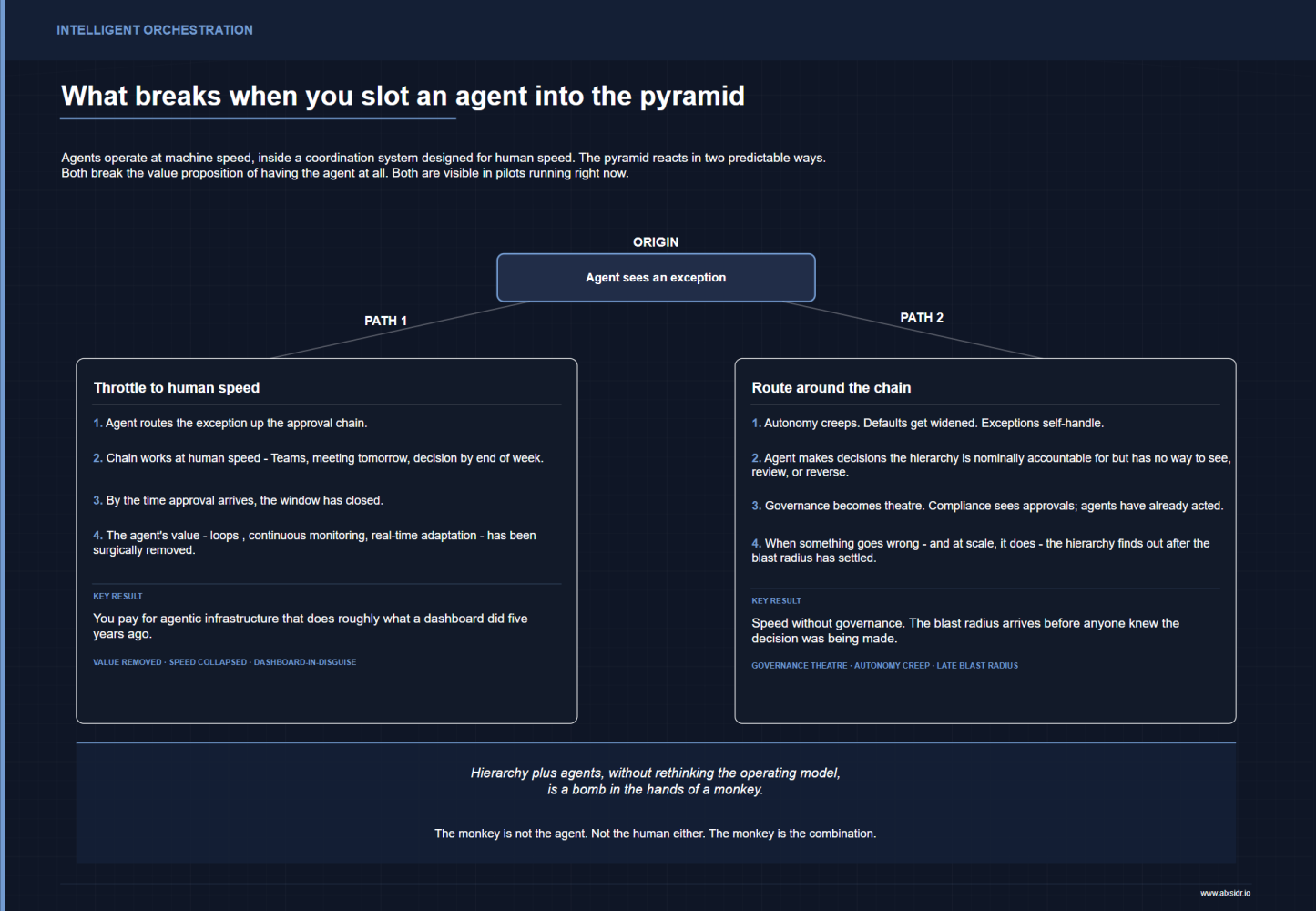
So what happens when you drop an agent into a hierarchical box? One of two things, every time.
You throttle the agent to human speed. The agent sees an exception in real time. It routes up the chain for approval. The chain works at human speed - Teams, meeting tomorrow, decision by end of week. By the time approval arrives, the window has closed. The agent's value - tight loops, continuous watching, real-time response - is gone. You're paying for infrastructure that does roughly what a dashboard did five years ago.
Autonomy creeps. Defaults widen. Exceptions handle themselves. The agent is making decisions the hierarchy is accountable for on paper but has no way to see, review, or reverse. Governance becomes theatre. When something goes wrong - at that speed and scale, something always does - the hierarchy finds out after the damage has settled.
This is the part sitting under every AI-native org chart I've seen past few days, and nobody wants to say it out loud:
Hierarchy plus agents, without rethinking the operating model, is a bomb in the hands of a monkey.
The monkey isn't the agent. Not the human either. The monkey is the combination. A system built for human speed trying to govern something that doesn't run at human speed.
What actually replaces the workaround
If hierarchy was the workaround for human limits, something has to carry the four TOM dimensions without depending on those limits.
That thing is the TOM itself. Made explicit. Made agentic.
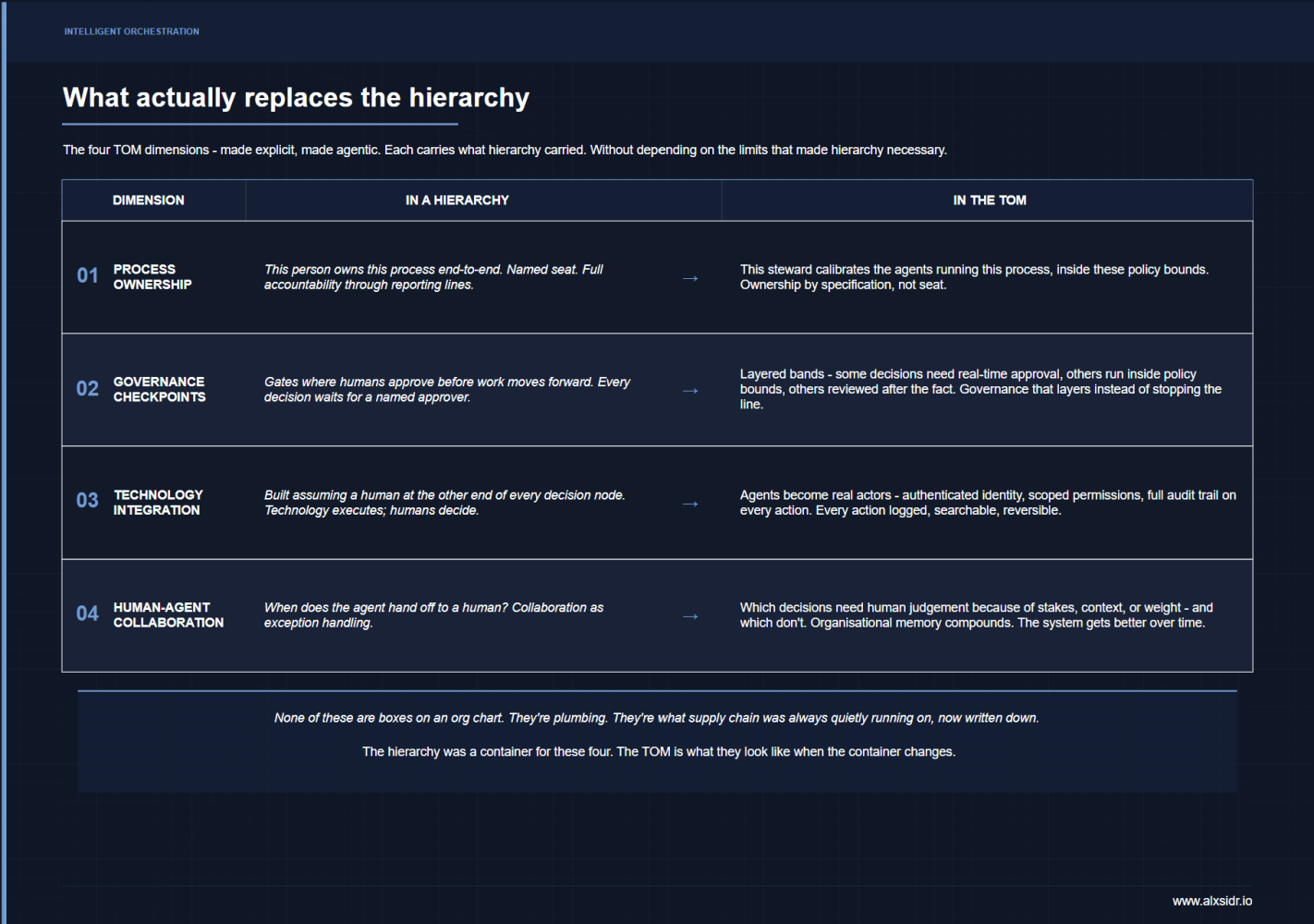
Process ownership stops being "this person owns this end-to-end." It becomes "this steward calibrates the agents that run this process, inside these policy bounds." Ownership by specification, not seat.
Governance checkpoints are no longer gates where humans approve before work moves. They become layered bands - some decisions need real-time approval, others run inside policy bounds, others get reviewed after the fact. Governance that layers instead of stopping the line.
Technology integration stops assuming a human at the other end of every decision node. Agents become real actors - authenticated identity, scoped permissions, full audit trails on every action. Every action logged, searchable, reversible.
Human-agent collaboration is the explicit design question of the whole operating model: which decisions need human judgement because of stakes, context, or weight - and which don't. This is where compounding organisational memory from Issue #4 lives. Corrections and overrides flow back into policy and context. The system gets better over time instead of standing still.
⫸ None of these are boxes on an org chart. They're plumbing. They're what supply chain was always quietly running on, now written down.
And the COO?
So where does that leave the Chief Operating Officer - or Chief Orchestration Officer, or whatever we're calling the seat this year.
Downstream.
The seat changes because the operating model changes, not the other way around. Call it Chief Orchestration Officer if you want. I do, sometimes - it's shorthand that lands with a CxO audience. But the real story isn't the title. It is that the thing the role was doing, running the pyramid, dissolves into something that doesn't need a pyramid.
The question for every operations leader reading this isn't how do I fit agents into my org chart? It's what was my org chart quietly solving for, and is the TOM now a better way to solve it?
Different questions entirely. One leads you to redraw boxes. The other leads you to do the work Issue #2 described - redesign the operating model itself, one dimension at a time.
The $53 billion is coming whether the operating model is ready or not. Hierarchy was the workaround. It worked brilliantly. It isn't the only shape available anymore. And it isn't the shape an agentic supply chain runs on.