For three issues the lens has been on the model - own it, don't rent it. Here is the half of the argument those issues left implicit: the model was never the part that mattered most.
Let me give you a broader context of Harness management before I reflect on why it matters for supply chain domain and what we should be mindful off in our operational realities.
In non-supply chain, technical world, a lot of AI professionals are arguing about models. I spot similar debates in my AI engineering group of connections who past few years are helping me with intensive hands-on exploration of art of possible in agentic engineering.
Across the last two issues, the lens stayed on the model. Issue 9 looked at it as a cost question - own it, don't rent it. Issue 10 looked at it as a continuity question - one Friday US government switched off the two best models in commercial deployment.
Both held up. Both are half the picture.
The model - owned or rented, frontier or fine-tuned - is the commodity. The thing around it is what's defensible.
There is also a point where it stops being just a vendor problem and becomes an enterprise architecture problem.
The detail behind 13 June
Go back to that Friday. Anthropic shipped Fable 5 and Mythos 5 on 9 June - the most capable models it had ever released. By 5:21pm Eastern on 13 June it had a formal export-control directive in hand, and within hours both models were dark for every user on earth. First time the US pointed export controls at the models themselves, not the chips underneath.
Here is the part that did not make the last issue.
Anthropic's other models stayed up. The teams that are welded to one model could be gone dark with it. The teams that could re-point at a different model were back inside an afternoon.
Same operation. Same data. Same business logic. One difference - whether the model was a foundation or a swappable part.
The teams that are capable swapping in an afternoon are not smarter about models. They had built a layer that made the model a setting, not a foundation. The rest had a clever text generator wired straight into production with nothing around it.
What actually carries the intelligence
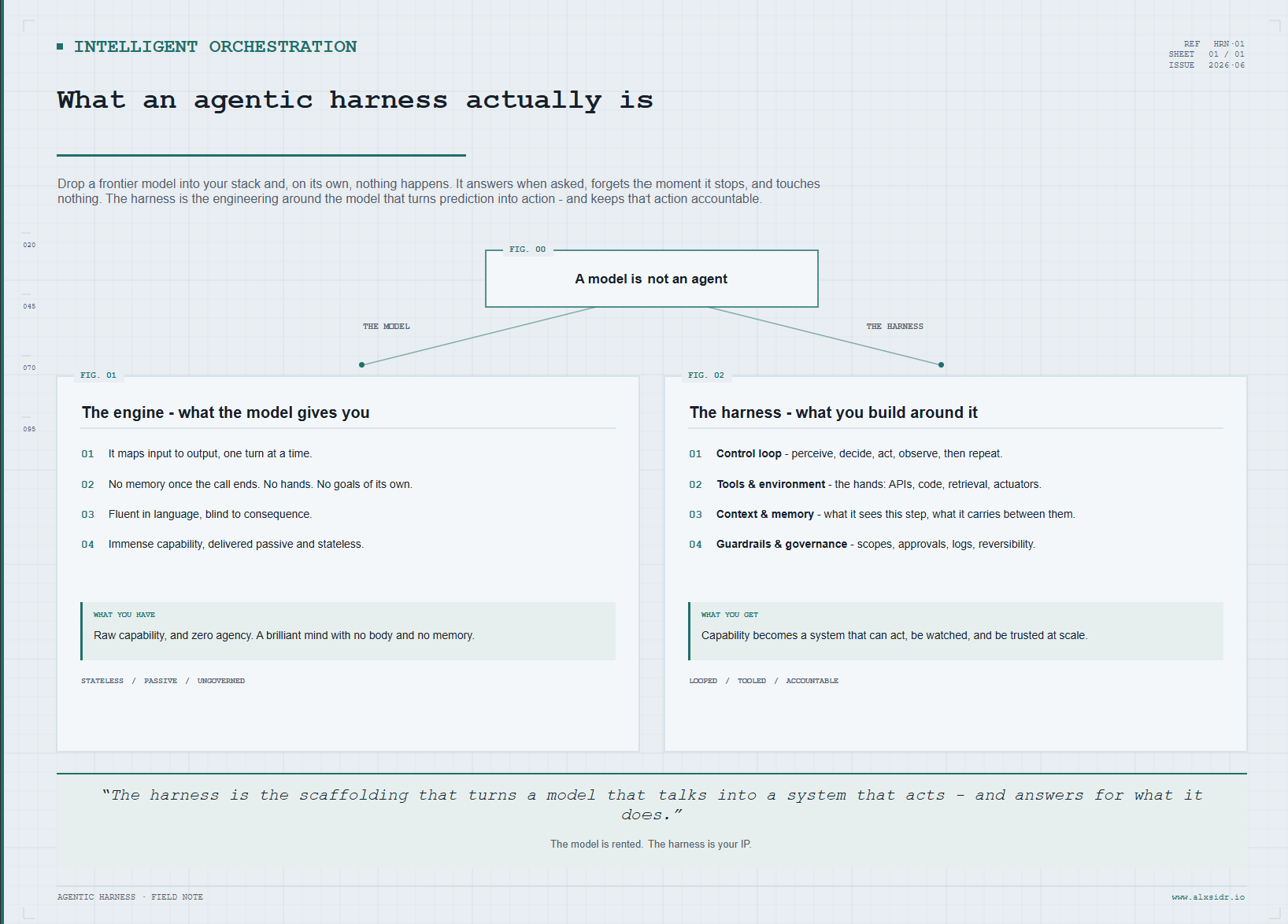
Call that layer the harness. It is everything around the model that turns a text generator into a system that does work: the orchestration that decides what runs in what order, the tools the agent can reach, the context you feed it, the memory it keeps, the governance that checks it, the routing that picks which model answers.
If you take one set of numbers from this issue, take these.
- On SWE-bench Verified - the standard test for AI doing real engineering work - six frontier models now sit within 0.8 points of each other. At the top, the model is no longer what separates a good agent from a bad one.
- Hold the model fixed and change only the scaffold around it. Princeton's CORE-Bench found the same model scoring 42% with one harness and 78% with another. Thirty-six points, zero change to the model.
- On the harder SWE-bench Pro, swapping the scaffold alone moves the score more than 22 points on identical weights. One team took a coding agent from the bottom of a benchmark to the top five by changing only the harness.
Anthropic's own engineers describe their flagship coding tool as the harness around the model - not the model itself. The people who build the models are telling you the model is the floor, not the building.
The model is one layer. The harness is everything else. Also based on my open experiments that I publish here: https://github.com/automatiqa-lab the model requires a lot of structure around it to get to the target objectives, so:
One layer you buy. The rest you build.
Why this is a supply chain story
Strip the jargon and you have seen this shape before. The harness is a control tower. Nothing more exotic than that.
A control tower is not valuable because of any single feed. It sits above the feeds, holds the context, knows the rules, and decides what to do. Swap a data provider and the tower keeps running. That is exactly what a good harness does for a model.
We already build this discipline for physical operations. Point it at intelligence and the layers are familiar:
- Orchestration - the planner that sequences the work and keeps humans in the loop for judgement, not routine.
- Tool access - how the agent reaches your ERP, your data foundation, your systems. Done right, this is abstracted behind a standard protocol. Amazon now ships a managed layer that gives agents authenticated access to systems through one fixed interface, so what sits underneath can change without rewriting the agent.
- Captured knowledge - the tacit operating know-how that lives in your planners' heads, written down where a model can use it.
- Governance - the audit trail, the approvals, the kill switch.
- Routing - which model answers which question, with a fallback for when one goes dark.
Gartner expects supply chain software with this kind of agentic capability to go from under two billion dollars in 2025 to fifty-three billion by 2030.
I personally read that as a forecast about harnesses. Nobody is spending fifty billion on raw models. They are spending it on the layer that makes models do the job.
This is where sovereignty actually lives
Issue 10 closed on four things becoming permanent. Every one of them is a property of the harness, not the model.
Multi-model architecture as risk management - that is the routing layer. Swap inside a day - only if the harness made the model a setting. Nationality and geography back in the sourcing decision - the harness is what lets you re-point at a sovereign or open-weight model when the export regime moves. A regulator on your tech roadmap - the harness is the shock absorber between their letter and your operation.
And a concrete response is already taking shape. In the two weeks since the Fable Ban, the enterprise playbook being written across the sovereignty guidance reads the same way everywhere:
- Insert a vendor-neutral abstraction layer - a model router - so switching providers is configuration, not code.
- Run a second equivalent model per use case, tested regularly, as a live fallback.
- Keep an open-weight, self-hosted backstop - Mistral, Llama, Teuken - that no directive can revoke.
- Secure data portability - reproducible embeddings, standard export formats - so the data is not the thing that traps you.
- Write exit clauses - data return, egress, retention, migration rights - into every contract.
Every line on that list is harness work. None of it is a model decision.
One caution, because it is the trap most likely to catch us. Build your harness on someone else's proprietary orchestration platform and you have not escaped the landlord - you have moved your dependency one layer up, where it is harder to see and harder to leave.
The harness only protects you if it is one you control.
The politics are catching up to the architecture. After Britain lost access overnight, its AI minister framed the episode as a case for sovereign capability - access to AI, he said, is now central to national security - and pointed to a £1.1 billion domestic AI investment as part of the answer. Nations are reaching for the same move enterprises are: reduce dependence on a model you do not control. At country scale that is industrial policy. At company scale it is a harness.
Sovereignty is not a model you own. It is a harness that does not care which model it holds.
Strip it back
Across three issues, one picture has formed.
Issue 9 - own the model, do not rent it. The cost case. Issue 10 - own the model, do not rent it. The continuity case. Issue 11 - the thing worth owning was never mainly the model.
The model is the part you can buy. Next quarter someone ships a better one, or a government switches yours off on a Friday, and it will not matter - because the model was always the replaceable part.
The harness is the part you have to build. It holds your knowledge, your governance, your control tower, your second source. It is slow to build, and it does not walk out the door when a competitor poaches your vendor.
Buy the model. Build the harness. Own the thing that does not change when the model does.